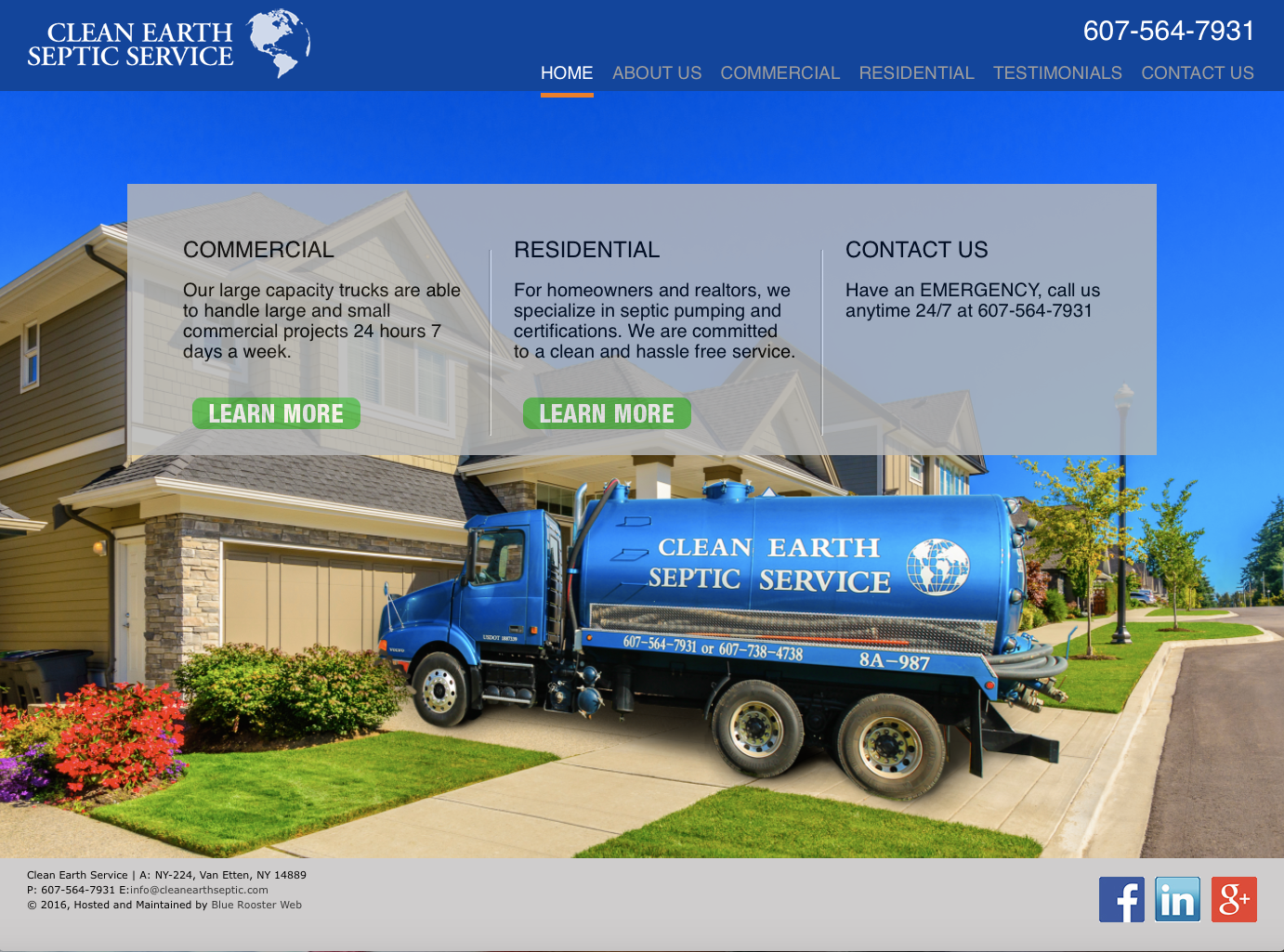
Today we are proud to launch Clean Earth Septic Service website as part of the Sun Sign Designs platform.

Digital Marketing News in the Tampa Bay Area and Vestal New York.
Today we are proud to launch Clean Earth Septic Service website as part of the Sun Sign Designs platform.
One of the biggest temptations when creating a strategy is to assume that it’s complete the moment you implement it. Your team can then focus on the actual execution of the components of the strategy along with maintaining its operations, right? Wrong. For business, it’s hard to imagine the circumstances where this would ever be a good idea. The demands of your customers, innovations of your competition and just the role of dumb luck will force you to modify your strategy in real time. Given that a typical business strategy can have many component parts, you’ll need to choose your battles in order to be successful in strategic modification. In this article we’ll go over some primary areas where you want to spend your focus.
All businesses depend on their clients and customers for their revenue and profits, and your strategy must account for their needs. Given the connectivity of your businesses, random events that impact them will always affect you, so it is essential that your strategy has a built-in client industry awareness so you can anticipate potential effects. It’s also important not to grow too attached to any particular aspect of your strategy because it may be rendered obsolete from a particular request or refusal from your client.
You can’t go wrong by focusing more on the content of your online marketing. From a strategic blueprint standpoint, content is the equivalent of the bricks to your building. You can use all the special affects you want to draw people in, but if you don’t have relevant content they’re going to wonder what the big deal was and leave disappointed. The keyword here is relevant: understanding changes in the industry will keep you ahead of the game and allow you to delight your customers with killer content.
Good communication, both internal and external, seems to be that elusive goal for all businesses to achieve, and for your online marketing strategy this couldn’t be more essential. Whenever there is a change to your strategy, all relevant parties should be made aware. Clients will need to know if there will be changes to their service levels. Employees will need to know if they’re doing the right work. Being able to trust your own company, vendors and contractors to execute when required will allow you to communicate with your clients with confidence, particularly when another strategic modification is required.
Understanding strategy is more than drawing up a plan and seeing if it will work – good strategy requires dedication and expertise. Sun Sign Designs knows all about that, as we make strategy the key to the services we provide to our own clients. Reach out to us today to learn more!
We here at Sun Sign Designs have lately focused on general topics and techniques to assist your company’s marketing. The reason for this is that it is essential that you have an understanding of how the fundamental concepts work together before delving into the more technical aspects of web presence. Today we’re focusing on one of those technical pieces: Latent Semantic Indexing, or LSI. This feature of Google’s search functionality ties directly in with one of our previous content topics, Search Engine Optimization (SEO), and it is critical to understand how LSI affects SEO in order to fully maximize your company’s online offering.
One of the simplest ways to describe LSI is to point out what it’s not, or to be more specific, what it’s replacing. For many non-marketing professionals, SEO is synonymous with Keyword Density, the easily exploitable system where the number of times a certain word is mentioned on your website will affect the location of your webpage rank in search results. While this may have been effective back in the early days of Google’s world-conquering search algorithm, using keyword density is no longer a viable option, as Google has phased out its use due to its contribution to inaccuracy for results.
LSI is the system that takes Keyword Density’s place. It groups words together into semantic systems, letting Google know when the related words on a website speak to a specific search. It’s best to show in examples: say you’re searching for Rolling Stones. Google knows that “Rolling” and “Stones” combines together to form the band name, and will avoid giving you results of rocks rolling down hills, even if that happened to be randomly trending at the moment. If you’re searching for an Oracle Developer, Google will know that you are searching for someone developing an Oracle database and not landscapers for ancient Greek monuments.
LSI does the heavy lifting for a user’s searches, connecting the informational dots, allowing Google to give more pertinent results for its visitors. So how can you capitalize on this new system? Content, as usual, is king here. Having high value content in every corner of your website will allow you to stand out among the crowd so that Google can use its LSI to your advantage. You look at your website and see well-made content—Google will see it as the brightest Christmas tree on the block when all the semantically related content relates with each other, catapulting your site above the rest to the top of users’ searches.
That last description doesn’t have to be an exaggeration for you—it can be a reality! Google prides itself on finding high value content, so it’s a triple win for Google, its users and your company if you have that kind of content on display for its search to find. Reach out to Sun Sign Designs today so we can give you all the technical knowhow of how LSI can help your business come out on top!
Tracking results is a critical piece to your overall business, and it is important that you’re watching the right results when investing in an unpredictable force like online marketing. It makes sense to look at the cost being put in to these efforts, along with the direct profits earned from what you rightly see as a financial investment. But online marketing has metrics that can be difficult to successfully track unless you are being mindful and diligent, such as overall market awareness and the timing of your measurements. By keeping these criteria in mind, you will be able to properly keep an eye on your businesses efforts so you’re getting the best bang for your buck.
Let’s say you have an electronics store, with a new marketing campaign centered on selling new computers. You advertise on your website that your $600 desktops are now selling for $500 for the month, and you watch in satisfaction as an influx of new customers arrives to your store. Marketing campaign success? Sure, more customers came, but how do you know your competition may have had to raise prices that month, or that you may have got more customers if you lowered the price to $475, or even better, used a more robust email follow-up campaign to reconnect with previous customers due for an upgrade? Business is always in flux, and monitoring just the direct profits of your marketing efforts may not be enough to tell you why you got more customers, or how you could have had an even larger number of people come to your store.
Timing your measurements correctly is a more controllable variable than knowing everything that is going on in your market, but it’s also potentially a harder concept to grasp if you’re not ready to think scientifically. Jayson DeMers explains in his recent column for Forbes that looking only at ROI forces a “skewed perception that slants toward short-term results.” In other words, it is human nature to attribute effects such as profits or losses to the most recent effort done by your marketing team, as opposed to the strategy and efforts put in during the history of the marketing project or website. Online marketing content has a long “half-life” on the internet – articles you publish today will remain there for years to come if left undeleted. Visitors may stumble across an article from 2013 from your website that happens to have topics trending in 2016, and decide to go with your services due to your wise advice. If your tracking is only measuring the visit without tracing it to the source, you may think those visitors were due to your most recent marketing efforts, therefore leading you to miss out on capitalizing on the new trend and the ability to connect with more prospects.
In either of these cases, it helps to have a team of professionals to handle the tracking so you can keep an eye on the bigger targets. Sun Sign Designs is staffed with experts ready to help you deal with these issues. We are able to conduct a full marketing strategic report for you so you understand the impact of your marketing efforts, along with a detailed of analysis of where you are getting your website visitors and how you can get more of them. Call us today to schedule your consultation!
When considering taking your business online, internet security is an issue that for some is a huge point of concern, and for others maybe it should be a bigger one. Owning an online business puts you at risk for virus attacks, malware, and malicious hacking attempts. And being a small business is no defense, and can actually be a bigger weakness—according to the International Data Corporation, small businesses account for 71% of the cyber security threats. Assaults on larger firms make for bigger headlines in the news, but no matter the size of your business, it is critical to decide how your company can handle the developing security dangers out there.
Back in January, Sun Sign Designs reported on the Internet of Things and the growth of previously non-online physical objects, including vending machines, umbrellas, biofeedback wristbands, etc. Given the potential for expansion in this field, it’s no surprise that independent inventors, small tech firms and global companies alike are looking to cash in on the possible smart object that will be the iPhone’s successor. But as Apple’s recent brush with the FBI shows, data encryption and security for your handheld phone is no lightweight matter, and it’s no accident that malware threats are increasingly targeting smart objects as the way to get into your precious files.
Up to now, most internet devices have had technology that included a processor that could handle connecting to the internet along with standard computing functions – think personal computers and laptops. As smartphones, e-readers, and gaming systems also went online, for the most part, they had a large firm such as Apple, Amazon, Microsoft or Sony backing the technology, so it was a logical step to imagine these firms handling thesecurity threats to these new types of internet-ready hardware. But the Internet of Things offers the opportunity for any electronic device to connect to the internet with its function. It’s this inherent deregulation of the concept that is the cause for alarm.
For small businesses, being aware of the potential threats is part of the battle. As Site Pro News reports, small businesses “are easier targets” for hackers to take on than global firms. They recommend an “ABC” approach to establishing a security presence:
Assess: Know what assets, resources and risks need to be protected; Build: An organizational security policy to be prioritized through leadership; Control: Establish the tools and control systems most suited to your organization and security blueprint; Deploy: Implement the tools; Educate: Ensure employees and executives understand the policy and are aware that security is everyone’s responsibility; Further: Continue to assess new security trends, conduct tests, and further integrate more powerful tactics in cyber-security.
Knowing the right approach to cyber-security involves having both the experience and the resources necessary in order to protect your valuable work. That’s why trusting the experts at Sun Sign Designs is the right call. We provide a full range of services that can be tailored to the specific security needs of your business. Reach out to us today!
Email is a critical piece to the puzzle of reaching and holding onto the attention of your customers, but often this powerful mode of communication is wasted. Email spam has become an accepted reality for most information age consumers, however that doesn’t stop some from employing heavy filters on their incoming mail to avoid having to deal with the garbage that is sent their way. Your company’s ability to establish a meaningful conversation with consumers will help keep you out of the snares of these filters so you can maintain your connection with your customers.
In many ways, email is one of the true equalizers in terms of communicating with a different party. Anyone can have an email address, and send email to and from that address. This is different than, of course, regular mail, which requires a physical location someplace to house the mail and actual postage being paid to deliver your message. One of the fundamental facts of email is that it’s free – a gift and a curse, as many companies and other nefarious entities choose to exploit email to send all kinds of nasty and pointless communication. And it’s the pointless communication that actually does email as a whole a disservice: we expect our filters to screen out the nasty stuff, but what of the generic cookie-cutter messages large corporations or well-meaning small businesses send out as a puny attempt to connect with thousands of consumers at once? The truth is, if these messages aren’t targeted or personalized, they do more than bore the consumer—they risk turning off the customer completely and lead them to find a new source of services.
The first step to writing effective emails is to just stop abusing the ability email provides where you can send a mass amount of messages at once. Sure, there’s nothing stopping you from sending out emails to every address collected by visits to your website, but you need to pause, take a breath, and ask yourself why you’re doing such a thing. You certainly don’t want people to regret having visited your website, as the wrong kind of word-of-mouth can spread faster than you can say “Kanye West Twitter feed.” Instead of doing this kind of easily avoidable damage to your brand, consider how identifying key issues for your prospective consumer can help establish that initial foothold to build a relationship going forward. They took the time to visit your website—do they have one of their own? Maybe a social media presence that’s open to the public could provide a few clues to writing the best message to them. Doing a little research on your end so that you can craft something meaningful for that person is simply a better strategy than firing away random messages into the wide expanses of the internet, hoping for a response that, in reality, has to be earned.
Whether you are starting a website from scratch or revising previous design situations, the way code is implemented on your website can have a big impact on the performance of your site on mobile devices. The words “code implementation” may make some non-technical professionals want to turn in the other direction to find a cute puppy or kitten video on YouTube, but it’s still an important decision for your website regardless of your level of expertise in the IT field. The reason for this is the growing presence of people’s use of mobile devices to access the Internet. If you’re not reaching these people, you are losing out on a growing segment of the marketplace that could one day easily replace desktop users completely.
For those who still feel that we’re speaking a foreign language when it comes to coding, the simplest solution is the best one for you in this instance. When Google released its new rules regarding coding implementation last year, they suggested what is known as “responsive design” to be the preferred choice for its browser. As ClickSeed explains, “Responsive design delivers the same code to the browser on a single URL for each page, regardless of device, and adjusts the display in a fluid manner to fit varying display size.” Easy enough—make responsive design the way your website implements coding, and both Desktop users and Mobile users will see the same content, just in a different manner given the screen size. So why would you choose something different? Two things: responsive design may create a slower experience for the mobile user if the webpage load is too big, which is a big no-no in the speedy world of mobile. In addition, responsive design discards the opportunity of designing a truly mobile experience for your visitors.
There are two other methods to try other than responsive design to give your visitors a more diverse field of options. For those not afraid of higher maintenance costs, separate URLs (website addresses) for Desktop and Mobile is an option. In this case, the mobile site is in a sub-domain of the main site (or some other kind of similar configuration), and this allows for more customization of the mobile platform. The drawbacks are obvious – the aforementioned higher cost along with the increased difficulty of monitoring for duplicate content on both sites. Those choosing this route are accepting higher upkeep for a richer overall experience for mobile users.
The final option is a hybrid choice between responsive design and separate URLs: dynamic serving. In this case, you are using the same URL for Desktop and Mobile, but the server knows to deliver different content depending on the device. At first this option seems like the best of both worlds: you’re able to customize the mobile experience while also keeping everything on one URL. However, the cost here comes in the dramatic increase of technical resources needed to operate dynamic serving. You will want someone who absolutely knows what they’re doing to implement this, and the upkeep is comparable to having separate URLs. In the future, dynamic serving may become an increasingly popular option as the cost and technical requirements for advanced computing continue to decline.
So which implementation is right for you? Do you have it all figured out, or are you still reaching for your YouTube bookmark to get a cute animal video fix? Regardless of your level of technical expertise, it’s still a very good idea to connect with web development experts in order to make the best decision for your business. Sun Sign Designs has been studying Mobile SEO before it became the phenomenon it is today, and we are ready to help you in this growing development in the online marketing field. Reach out to us now!
What if we asked you to grade your website? Would you give it an A out of beaming pride, a B as an acknowledgement of a future business project, or maybe a C with a shrug and a smirk, silently saying to yourself, “who cares?” Well, none other than our friends over at Google care. Google employs “Search Quality Evaluators” to monitor individual websites in order to rank them in their search engine algorithm, and if your website doesn’t meet their criteria, any previous attempts you have made to boost your ranking could be made pointless. Google recently updated their evaluator guidelines, and it is vital for the continued online growth of your business that you have an understanding of these new rules.
For some, it may come as a shock just to realize that there are actual real life people ranking individual websites for Google. What about those fancy keyword algorithms and automated web crawlers it uses to decide search rank? (Actually it will likely be more comforting for some to know that real people are taking over for the robot spiders.) Google is well aware of SEO marketers attempting to “game” their algorithm and automated features, finding loopholes in the system through cheap Black Hat SEO practices. And while you may really feel that you are helping the broader population by boosting your website’s rank with standard SEO – making sure to prioritize popular search terms in your articles, and providing answers to commonly asked questions – Google has its own opinion on what meets their criteria. And that opinion can be boiled down to two words to remember: expert content.
By employing human readers to judge for expert content, Google is able to bring a silent sense of certification and rigor that is often lacking in the darker corners of the Internet. Site evaluators are tasked with following a simple acronym E-A-T to determine expert content: E for expertise, A for authoritativeness, and T for trustworthiness. In a sense, these are all self-explanatory, but it is essential for you to know that Google is grading you on these items. It’s worth taking another look at your web page (see, we are asking you to grade it after all) and check if you measure up to these standards. Would you say that a sense of expertise and authoritativeness shines through the text and images? What other sites does your website link to that show it can be called a trusted source of information? And most importantly, how would a complete stranger rate you in these areas? It’s this last question that you have to be able to answer satisfactorily in order to rest assured that you’re making Google’s grade.
As with most things involving the internet, this article doesn’t even begin to scratch the surface of the intricacies involved with meeting Google’s new content standards. That’s why reaching out to Sun Sign Designs will be a great help to your business. We’ll be able to provide you with all the information necessary to meet these new demands so your company can continue to grow. Contact us today!

As mobile devices increasingly become a part of our daily lives and routines, smart marketers know that the fastest growing way to reach consumers will be through their phones. Is your online strategy suited to connect with consumers in this fashion? The rules of website development change when your consumer’s viewing space is less than 3×5 inches and there are literally hundreds of possible distractions available on the same device, let alone the world around them, to keep your customers’ attention away from what you’re trying to say. By following the below best practices that are geared towards Mobile Marketing and Search Engine Optimization, your company will be well-positioned to take advantage of this market as it continues to grow.
Just as mobile operating systems caused application developers to rethink their approach to design, mobile web rules are forcing marketers into adapting to the new platform. First and foremost, your company’s web page loading speed is essential—mobile devices are built to give consumers’ access to all their favorite applications with a touch of a button, and if your website can’t compete at that same pace, it might as well not exist as far as the consumer is concerned. This also means that content in Flash and Pop-ups should be used very carefully in your mobile site, if at all. Not every phone is optimized to use Flash, and a failure to load content, or to have it blocked by a distracting pop-up ad will be a surefire way to lose a good portion of your consumers.
In fact, the way consumers interact with mobile devices may cause you to reconsider your entire internet marketing strategy altogether. It’s no coincidence the rise of social media’s ability to drive web traffic has correlated with the wider use of mobile internet devices. Facebook, Twitter, and Instagram are ideal for consumers to quickly view items, favorite them, and to leave a comment for others to see. A robust social media presence for your company will allow you to appeal to these users. And depending on your company’s bravery and how much money you have budgeted for it, you can take the plunge into mobile application development itself, much in the same way that Nike, Under Armour, and even food services such as Taco Bell have done. It’s true that these are all examples of large companies who have the massive budget available for this kind of expansion, but the rapid success and growth of a firm such as Uber demonstrates how the right mobile application can remake an entire industry into one company’s favor.
The mobile platform is here to stay for the foreseeable future. Given that, whether or not your company will be here for that long will depend on no small part on its ability to be appealing to consumers on mobile devices. This is advanced level stuff—your digital strategy, social media, regular SEO, email follow-up, website conversions, website analytics, namely everything needs to be on point before you can dream of dominating the mobile device field. And Sun Sign Designs is here for you. By handling the infrastructure and essential components of your marketing strategy, we’ll help you optimize your site so you can capitalize on this necessary platform. Don’t hesitate—reach out now!
The start of a business is one of the most momentous occasions in the lifetime of any company. And when you’re at the beginning, you make the decision relatively early on if you’re going to have a website for your customers to see. It can be a yes-no decision, or an item where you’ll get to it “someday.” Once the decision has been made, you move on to more pressing matters, and if the website plan has been kicked to the curb, it’s possible that you never went back to it. Many small companies feel that they are unable to afford a website or even handle the positive growth effects it can bring to their businesses. By leveraging the right resources and partners, your company can move beyond such limitations and take advantage of the huge opportunity provided by owning a website.
If you’re in the business of producing media, having a website may seem like a no-brainer, as it offers a cost-effective solution to showcase your products. However, if you’re not producing media that can be digitized easily, then the appeal of a website may not be as obvious. You may feel your product or services speak for themselves, so the idea of relying on images or videos may feel off-putting to your cash-strapped company. It’s this second group that needs the current pep talk.
Having your own website is a critical and necessary driver of revenue in our current market. An increasing number of customers and leads are found online, and not having a website means there is no way for interested parties to find out more about you, and you have no way of controlling your brand online. A random disgruntled customer could write a review of your company on Yelp or the Better Business Bureau website, which may become the first result that comes up from Google when people search for you. Translation: not good. Also, as internet savvy millennials continue to enter the workforce, gain access to company budgets, and become heavy-hitting corporate decision makers, it is vital for your company’s continuing existence to reach this escalating market of untapped potential.
Uncontrolled growth is another concern besides cost that holds back some companies from taking the crucial step of going online. Having a website will without doubt increase the demand and scrutiny upon what your company has to offer, and many small businesses may not wish to participate in the unorganized chaos that sometimes correctly describes the internet. Uncontrolled growth can be just as damaging as rapid decline for some companies, and cautious firms may wish to stay off the radar to avoid the pressure of being in the public eye. In this case it’s important to consider how your website can be constructed so that customers are directed to the information that matters, as opposed to how messy sites look when they were made by a team of unpaid interns. Less is often more in business, and having a beautiful, elegant site can appeal to your own tastes and allow customers to feel like they are working with truly professional partners.
Your company is never too small to have a website. And while there are many cheap solutions online that will allow you to slap together something in a hurry, is that really how you want to appear to the masses of new customers waiting to utilize your services? Turn to Sun Sign Designs for help, where we will allow you to create the website of your dreams while keeping within your budget. Reach out to us today!